/ 20 Years of Creating Pathways to Safety: RefugePoint’s Indirect Contributions to Global Refugee Resettlement
Updates & Insights
20 Years of Creating Pathways to Safety: RefugePoint’s Indirect Contributions to Global Refugee Resettlement
All posts
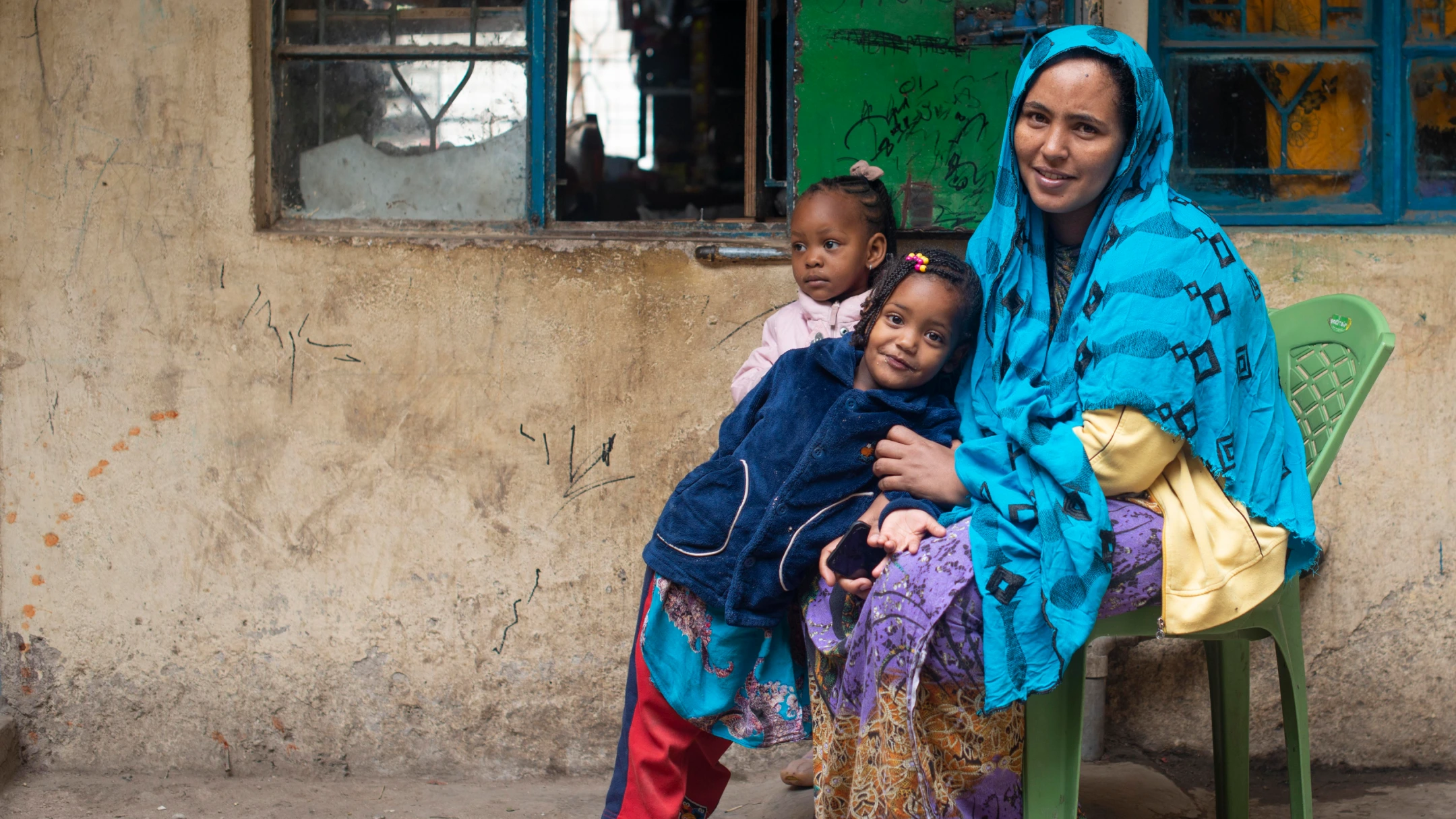
Kavira and her family outside their home in Canada. Photo: Ali Pappavaselio, RefugePoint
Published on12 December 2025
By Patrick Guyer and Amy Slaughter
Resettlement as a Life-Changing Opportunity: Kavira’s Story
The path that brought Kavira and her children to safety in Canada spanned years, winding through multiple countries across two continents. A businesswoman in her native Democratic Republic of Congo, Kavira’s success made her a target during civil unrest. Fleeing with her children to Kenya, Kavira’s health deteriorated as she struggled to make ends meet in their new surroundings. After a chance meeting with a RefugePoint staff member at a Nairobi hospital, Kavira went on to receive medical care, counseling, food, and rent assistance from RefugePoint, as well as a small grant to restart her business. These supports helped stabilize Kavira and her family, but Kavira’s health continued to worsen, the most pressing protection challenges and vulnerabilities they faced remained. Kavira’s life drastically changed when she, along with her two young sons and daughter, resettled to Canada in 2023. With regular medical care, the family has found a new sense of hope as they rebuild their lives among a welcoming community.
RefugePoint’s Indirect Impact on Refugee Resettlement
Kavira and her family are just a few of the 136,000 refugees RefugePoint has worked with directly to access resettlement to a safe country over the past twenty years. But the reach of our work with refugee resettlement goes much further than that: a recent analysis of our historical data shows that our work has also indirectly contributed to more than 209,000 refugees being referred for resettlement worldwide since 2005, the year RefugePoint was founded. To put this in context, this means that RefugePoint has in some way touched almost 17% of the more than 2 million refugees referred for resettlement worldwide in the past 20 years, either directly or indirectly.
How did we determine this? RefugePoint contributes indirectly to refugee resettlement worldwide in numerous ways. These include:
Advocacy with high-level decision makers for specific populations and locations
Prioritizing equitable access and needs-based resettlement
Inspiring partner organizations to adopt our approaches
Building a pipeline for new resettlement caseworkers
Deploying staff to work on resettlement casework alongside partners
Training partner staff on resettlement identification and casework.
Of these, RefugePoint’s Monitoring, Evaluation, and Learning (MEL) team has good-quality, historical data available for the last two. Our estimate focuses on the indirect impacts of staff deployments and trainings we’ve done to strengthen the capacity of partners to do more, and better-quality resettlement identification and referrals.
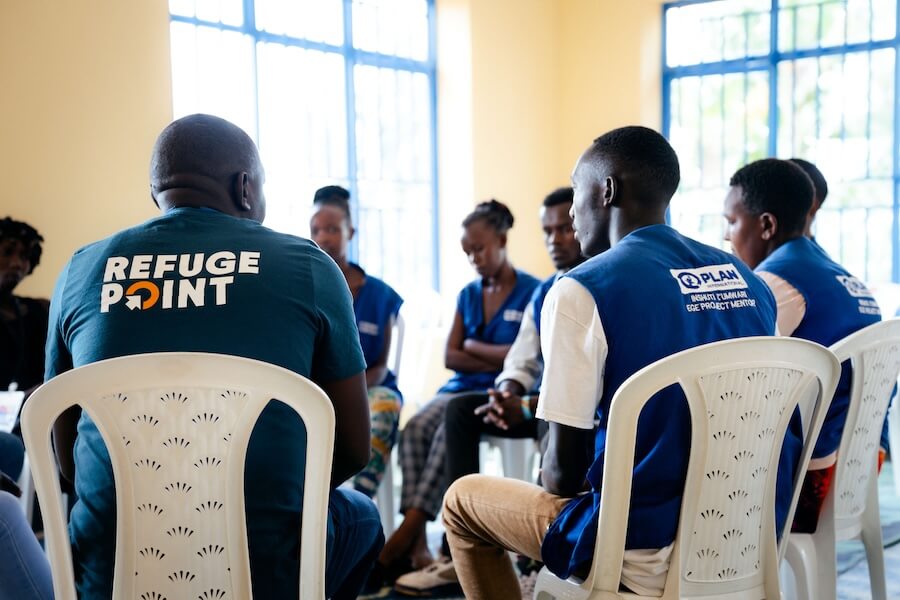
A RefugePoint Expert oversees a youth advisory group in Rwanda. Photo: Chris Jensen, RefugePoint
RefugePoint Deployments: Unlocking Resettlement Potential in Underserved Countries
To understand the indirect impact of staff deployments, we dug into records of the work we’ve done with refugees in 85 countries worldwide over the past 20 years. A large part of this work focused on expanding equitable access to resettlement by lobbying to deploy staff to locations where little or no resettlement casework had previously been done, notably Southern Africa. RefugePoint identified this gap and lobbied the United Nations High Commissioner for Refugees (UNHCR) to deploy resettlement staff to refugee camps and UNHCR offices across Southern Africa. RefugePoint was among the first NGOs to work with UNHCR in this way, paving the way for other NGOs to join the effort. In the years that followed, RefugePoint grew its presence through direct deployments in several countries in the region where little or no resettlement work had been done before, including Botswana, Malawi, Mozambique, Namibia, Zambia and Zimbabwe.
RefugePoint staff have also helped strengthen policies, procedures, and systems for resettlement in countries and refugee camps during deployments, contributing to the quality and quantity of resettlement casework done by our partners, even after deployments end*. We developed a detailed mapping of the countries where deployed staff have worked and in what years, matched with the volume of resettlement and related casework done over time. This allowed us to estimate the share of resettlement referrals made by partners in countries and years where RefugePoint has been active that we’ve contributed to indirectly.
Deployee Trainings Further Expanded RefugePoint’s Impact
To estimate the indirect impact of training, we found that of the nearly 13,000 partner staff trained by staff between 2005 and 2024, about 30% received instruction on topics related to resettlement identification and casework. To estimate the indirect contribution of this to resettlement referrals, we posed the question: what if each partner staffperson trained on resettlement did even half as much resettlement-related casework as a typical RefugePoint staff member on deployment, for just three months? We make these assumptions because we wouldn’t expect a newly-trained partner to be as productive as a seasoned staff person coming right out of being trained, and three months is the minimum duration of a typical staff deployment. Using historical records from our deployed staff, we crunched the numbers to determine the contribution of training to our indirect resettlement impact.
Adding together the contributions of staff deployments and training gives us a final estimate of the indirect reach of our work on global refugee resettlement of about 209,000. We recognize and respect that this is also part of our partners’ direct impacts through their own work. We also claim this as part of our indirect impact only to highlight our contributions to the excellent efforts of those partners.
Looking Ahead: Work Still to Be Done
As we highlight this achievement, we also recognize the work still to be done, especially at a time when our hard-fought gains to make refugee resettlement equitable and accessible are being harshly and hastily rolled back. Global refugee resettlement looks set to plummet from 189,000 refugees resettled last year to likely fewer than 30,000 in 2025. To make matters worse, resettlement opportunities are becoming less equitable than in previous years, with the majority of resettlement slots being allocated by politics, rather than humanitarian principles. This means hundreds of thousands of refugees facing extreme vulnerabilities remain trapped in limbo under dangerous conditions, cut off from the chance to rebuild their lives in a safe third country. In this new environment, RefugePoint and partners must work together to bring back equitable resettlement opportunities for refugees. Leveraging lessons we’ve learned from 20 years of contributing to expanding equitable access to resettlement and other pathways to safety for refugees—indirectly as well as directly—we are ready to step up to this challenge.
* This includes three years after departure of RefugePoint staff, in locations where RefugePoint’s engagement ended or was paused.
RefugePoint envisions an inclusive world where all refugees can safely build stable, connected, and thriving lives. Our Theory of Change (ToC) shows how we’re turning that vision into action. The...
Over the past year, the world has shifted in ways that have made life far more dangerous and uncertain for refugees. Support systems that once offered stability are eroding: global...
This week marks the 2025 Global Refugee Forum Progress Review in Geneva, Switzerland: a time for the international community to take stock of our progress on the pledges that we...
Join Our Community
Stay in the know about our work with refugees: get refugee stories, events, RefugePoint news, and more delivered right to your inbox.
Subscribe to get refugee stories, events, RefugePoint news, and more delivered right to your inbox.
By subscribing you agree to with our Privacy Policy & provide consent to receive updates from Refuge Point.
Give hope by supporting refugees today
Your gift will be used to deliver lasting solutions for refugees around the world, and help them rebuild their lives in safety.