/ Blog / RefugePoint’s Theory of Change: Our Roadmap to Impact
Impact
RefugePoint’s Theory of Change: Our Roadmap to Impact
All posts
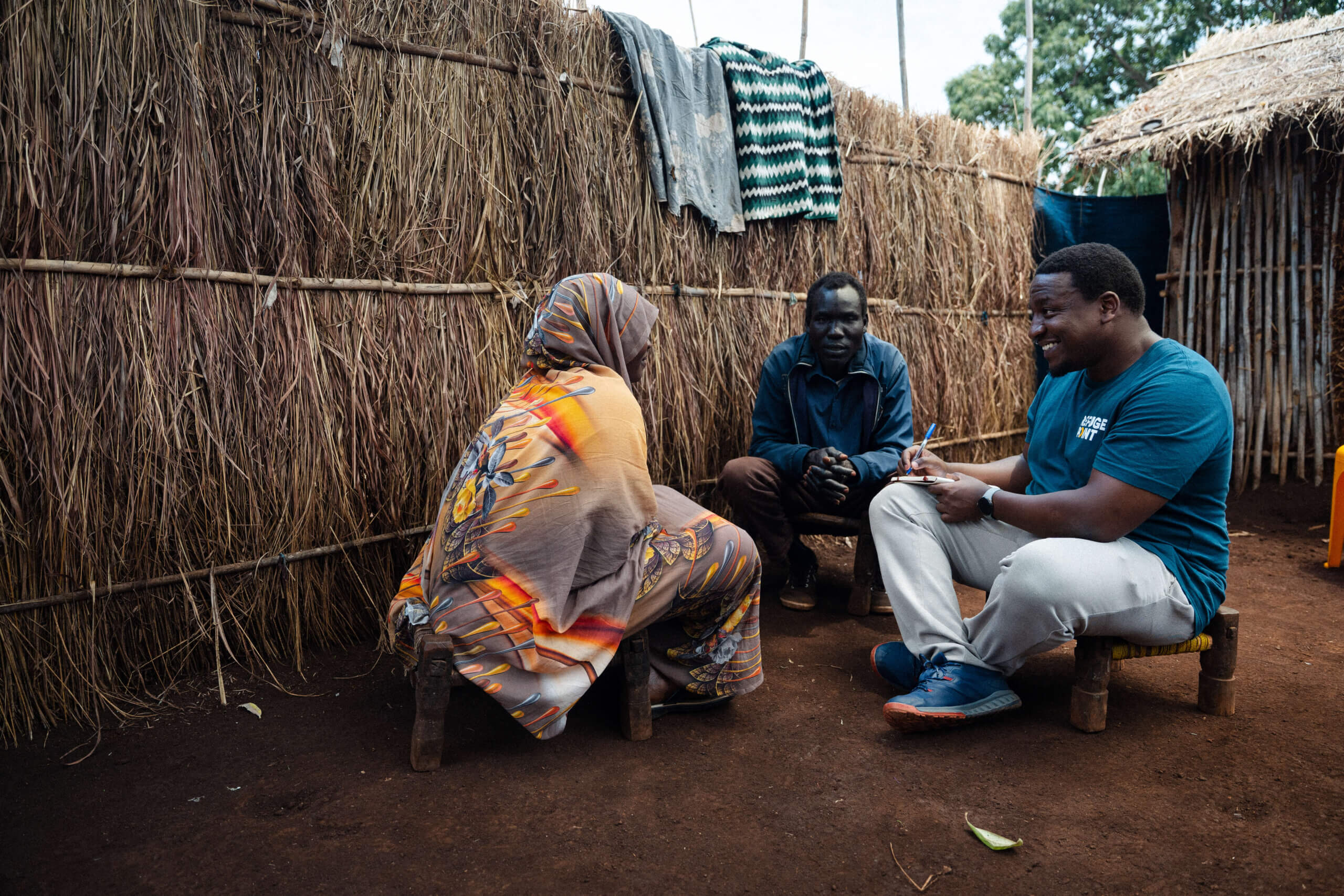
A RefugePoint Resettlement Expert and UNHCR staff member speak with a refugee woman from South Sudan, living in Tsore Refugee Camp, Ethiopia. Photo: Chris Jensen, RefugePoint
Published on9 January 2026
By Patrick Guyer, Director of Impact, RefugePoint
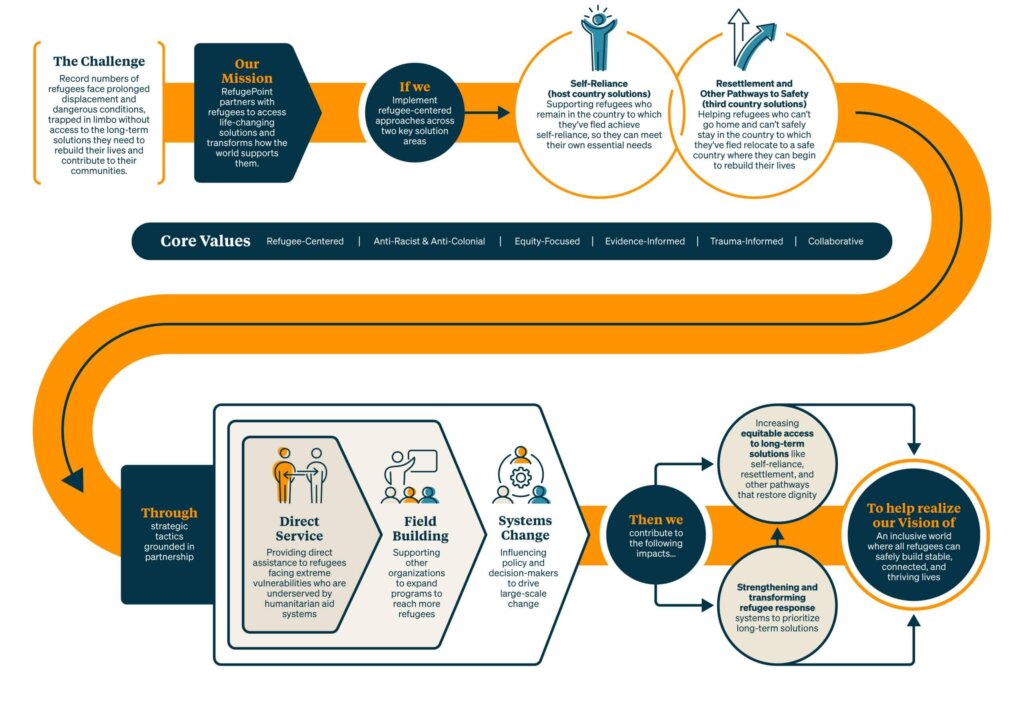
RefugePoint envisions an inclusive world where all refugees can safely build stable, connected, and thriving lives. Our Theory of Change (ToC) shows how we’re turning that vision into action. The ToC is a roadmap for how we’re stepping up and responding to the challenge of record numbers of refugees facing prolonged displacement worldwide. It’s a visualization of what we do and how our work leads to positive impacts for refugees, centered around our guiding core values.
We created this ToC to show how the different lanes of our work merge together into one single route towards impact for refugees. We use the ToC to present who we are and what we do to new supporters and stakeholders, and as a tool to help us reflect on our own work, so we can adjust and adapt our approach to stay as effective as we can be.
Click here for a downloadable PDF version of RefugePoint’s Theory of Change. Click here for the Kisawhili version.
What is the problem RefugePoint is trying to solve?
Our journey to impact begins with the challenge refugees and the world face right now: more than 42 million people are refugees, as of mid-2025. That’s more than the entire population of Canada, and twice the number of refugees there were 20 years ago. Many refugees are displaced for years, even decades. Far too few can access the long-term solutions they need to rebuild their lives in safety and contribute to their communities.
How is RefugePoint working to find solutions to these problems?
We tackle this challenge through the programs that we run, all of which put refugees at the center of our work. Our programs span two key solution areas:
Self-Reliance: Helping to open up opportunities for refugees to use their skills and strengths to meet their own basic needs in the country to which they’ve fled, and
Resettlement and Other Pathways to Safety: Helping refugees relocate to a safe country where they can rebuild their lives.
There is no impassable divider between these two solution areas; in fact, they have a shared lane, as indicated by the overlapping bubbles in the graphic. Refugee self-reliance programming, which includes elements like education, skill-building, entrepreneurship, child protection, physical and mental health care, etc., in host countries, can support refugees to pursue any durable solution, including relocation to a safe third country.
What are RefugePoint’s Core Values, and How Do They Impact Our Work?
RefugePoint’s core values guide everything we do. They’re not a “stop” on the roadmap because they’re a part of the entire journey. We reference our values when making decisions at all levels, whether that’s developing long-term strategy, drafting annual plans and budgets, or tweaking program designs to maximize impact for clients.
Refugee-Centered: RefugePoint is committed to ensuring that refugees are an integral part of our programming and elevating refugee voices and leadership within the organization and the broader humanitarian community.
Anti-Racist & Anti-Colonial: Recognizing that racism, colonialism, and global white supremacy have caused many of the inequities driving the world’s refugee situations, we integrate anti-racist and anti-colonial principles into our internal policies and systems, as well as our programs and partnerships.
Equity-Focused: RefugePoint aims to strengthen equity in the humanitarian sector through our work delivering services, sharing resources, building capacity, and influencing policies and systems.
Trauma-Informed: RefugePoint strives to integrate a trauma-informed approach into our programs and offer mental health and psychosocial support (MHPSS) services to clients and staff.
Evidence-Informed: RefugePoint uses an evidence-informed approach that integrates expertise from both staff and clients alongside evidence from research, reporting, monitoring and evaluation, and other sources.
Collaborative: We seek opportunities to share mutual learning and strengthen the capacity of local and global partners, to find solidarity with displaced and host communities, and to accelerate impact through engaging in, building, and leading networks and consortia.
What are RefugePoint’s Strategic Tactics?
Our journey towards impact continues towards our three strategic tactics, all grounded in solid partnerships with other organizations in our sector. These include:
Direct Service: providing direct support to refugees facing extreme vulnerabilities who are underserved by humanitarian aid systems
Field Building: supporting other organizations to expand programs to reach more refugees
Systems Change: influencing policy and decision-makers to drive large-scale change
The nesting of the shapes for each of our three strategic tactics is intentional, to show how the scale of impact expands with each one. Our work is anchored in the direct service work we engage in with refugees, in support of both building self-reliance and pursuing resettlement and other pathways to safety. We capture and distill lessons learned and best practices from our direct service work about how to continually improve the effectiveness of our work. This insight and know-how drive our field-building efforts to strengthen the refugee response sector, and give us the credibility and experience we need to engage in systems change, influencing, and advocacy at the national, regional, and international levels.
What Kinds of Impacts is RefugePoint Working to Achieve?
The next stop is impact, in two key areas:
Increasing equitable access to long-term solutions like self-reliance, resettlement, and other pathways that restore dignity, and
Strengthening and transforming refugee response systems to prioritize long-term solutions.
We highlight these two impact areas separately, but they are intricately linked. Strengthening refugee response is an end in itself, but also a means to increasing equitable access for refugees to long-term solutions. That’s why an arrow points from strengthening and transforming refugee response towards increasing equitable access to long-term solutions.
How Does RefugePoint Measure Its Impacts?
RefugePoint staff carry out robust monitoring of our work with refugees and partners across all our programming. Data about the number of refugees we’re supporting to access long-term solutions is reported quarterly, aggregated, verified, and shared in our publicly available quarterly impact reports.
Not all of our impacts can be easily captured with numbers. To document and evaluate how we’re strengthening and transforming refugee response systems, RefugePoint has commissioned externally-led, qualitative evaluations to highlight our contributions to changing refugee response. So far, we’ve documented eight examples of how we’ve done this over the past 20 years, ranging from strengthening protections for refugee children to launching a global movement to promote refugee self-reliance to working to secure inclusion of refugees in Kenya’s national health insurance system.
Conclusion: RefugePoint in 2026 and Beyond
Together, these impacts are how we contribute to fulfilling our vision of an inclusive world where all refugees can safely build stable, connected, and thriving lives. There’s no getting around the fact that today, realizing this vision feels very far off. Tens of millions of refugees are seeking safety and a chance to rebuild their lives, while governments worldwide are slashing the funding that could help them do so, and slamming shut doors to refugee resettlement.
In spite of this, we’re confident that if we double down on refugee-centered approaches and rally our partners to push for the change we need in refugee response systems, we can navigate the route towards impact, no matter how difficult the road ahead.
By Shelby Quackenbush (Refugee Self-Reliance Initiative), Sofia Casas and Peter Ventevogel (UNHCR), and Anna Nicol (RefugePoint), on behalf of the full team of White Paper authors, including Awa Ahmed Haji...
With refugee resettlement opportunities at their lowest level in decades, it is all the more important to consider how those coveted quotas are allocated across regions and countries. The strategic...
Read Transforming Refugee Response: Vol. 9, Shifting Systems to Open and Expand Labor Mobility for Refugees Chol fled to Kenya at the age of 14 after conflict forced him...
Give Hope: Support Refugees Today
Make a gift to deliver lasting solutions for refugees and help them to build new lives.
Join our Community
Subscribe to get refugee stories, events, RefugePoint news, and more delivered right to your inbox.
By subscribing you agree to with our Privacy Policy & provide consent to receive updates from Refuge Point.
Give hope by supporting refugees today
Your gift will be used to deliver lasting solutions for refugees around the world, and help them rebuild their lives in safety.