/ Blog / Strategic Use of Resettlement: Strategic for Whom?
Resettlement
Strategic Use of Resettlement: Strategic for Whom?
All posts
Soe, Say and their family at their home in Tham Hin Refugee Camp, Thailand. While awaiting resettlement, Soe's family make a living crafting traditional goods from Myanmar. Photo: Chris Jensen, RefugePoint
Published on19 September 2026
By Martin Anderson, Chief of Policy & Practice / Geneva Representative, RefugePoint
With refugee resettlement opportunities at their lowest level in decades, it is all the more important to consider how those coveted quotas are allocated across regions and countries.
The strategic use of resettlement (SUR) was a featured topic at this year’s Consultations on Resettlement and Complementary Pathways (CRCP), held June 15-16, 2026 in Geneva, Switzerland.
Strategic Use of Resettlement in the Past: Humanitarian Focus
Historically, the term strategic use of resettlement has meant “the planned use of resettlement in a manner that maximizes the benefits, directly or indirectly, other than those received by the refugee being resettled. Those benefits may accrue to other refugees, the hosting state, other states or the international protection regime in general.” That definition—which originally comes from a formal Working Group on Resettlement meeting led by UNHCR in 2003—was shared with participants at this year’s CRCP as a reminder of the intent behind the terminology.
While the definition is broad, envisioning a wide variety of benefits accruing to various stakeholders, historically the emphasis has been on benefits for other refugees or their host countries and communities. The classic example of SUR is the idea that the departure of some refugees from a certain context might make it easier for the host country to offer expanded rights for the remaining refugees or to maintain an open border for new refugees fleeing persecution.
There are some examples of successful implementation of this version of SUR over the years, though they are all limited in various ways:
In approximately 2006-2008, a “comprehensive solutions” plan was devised to try to resolve the protracted situation of Burundian refugees living in Tanzania since 1972. Over 10,000 were resettled, primarily to the United States; around 50,000 were supported to return to Burundi; and nearly 200,000 were to be naturalized in Tanzania. The resettlement commitment was a key leverage point in negotiating this arrangement. It is currently disputed, though, the degree to which naturalization was granted in the end.
In approximately 2015-2020, resettlement was seen as a form of international solidarity with Jordan, Lebanon, and Turkiye, all of which were hosting large numbers of refugees from Syria. It was, rhetorically at least, coupled with other pathways such as labour mobility and education opportunities to offer third country solutions to as many refugees as possible and thereby alleviate at least some of the burden and responsibility these frontline countries were facing.
And in 2025, resettlement was linked to Thailand’s decision to allow work rights for about half of all refugees living in camps along the border with Myanmar. A pre-existing large scale resettlement program was seen as something like a precondition for the new policy, since it affords a solution for some of the refugees who are unable to work.
These are some of the classic examples of SUR. All are imperfect in their own way, but they all suggest an orientation towards the idea that SUR is meant to maximize the benefits that accrue to other refugees and/or the host country.
Strategic Use of Resettlement Today: More Political?
As political winds have changed in recent years, this orientation has shifted radically. While the original meaning of SUR has not been abandoned, it is now accompanied by, and arguably overshadowed by, a newer version of the term, in which the strategic benefit accrues not to other refugees or host communities but to destination countries and their domestic political priorities. It is the resettlement version of an argument playing out elsewhere, in which aid and development programs are being repurposed to serve the foreign policy interests of donor states first and foremost.
One example of this can be seen in the way that resettlement is being deployed within the “route-based approach,” a joint IOM-UNHCR initiative to provide cross-border supports to migrants and refugees moving along known migration routes.
A foundational principle of the route-based approach is that individuals should have access to services and solutions wherever they are, so that they see viable alternatives to onward journeys through irregular, often dangerous means, which can include the use of smugglers and traffickers. One of the six pillars of the approach is access to safe and regular pathways, the idea being that someone migrating to reunite with their family, for example, may be willing to stop and wait for a legal migration process if it is available in a timely, affordable way.
Though resettlement is not specifically named as a core feature of the route-based approach, the same logic applies. Indeed, there is a long history of efforts to minimize the potential “pull factor” of resettlement – the idea that refugees in one country may be motivated to move to a neighboring country if resettlement appears more accessible there. Viewing the route-based approach through this lens, one might expect to see a relatively equitable distribution of resettlement quotas along the length of a migration route, to minimize the potential perception of a pull factor.
What we are seeing in practice is the opposite. Based on UNHCR’s Projected Global Resettlement Needs document for 2027, refugees are many times more likely to have access to resettlement the nearer they get to the end of a major migration route.
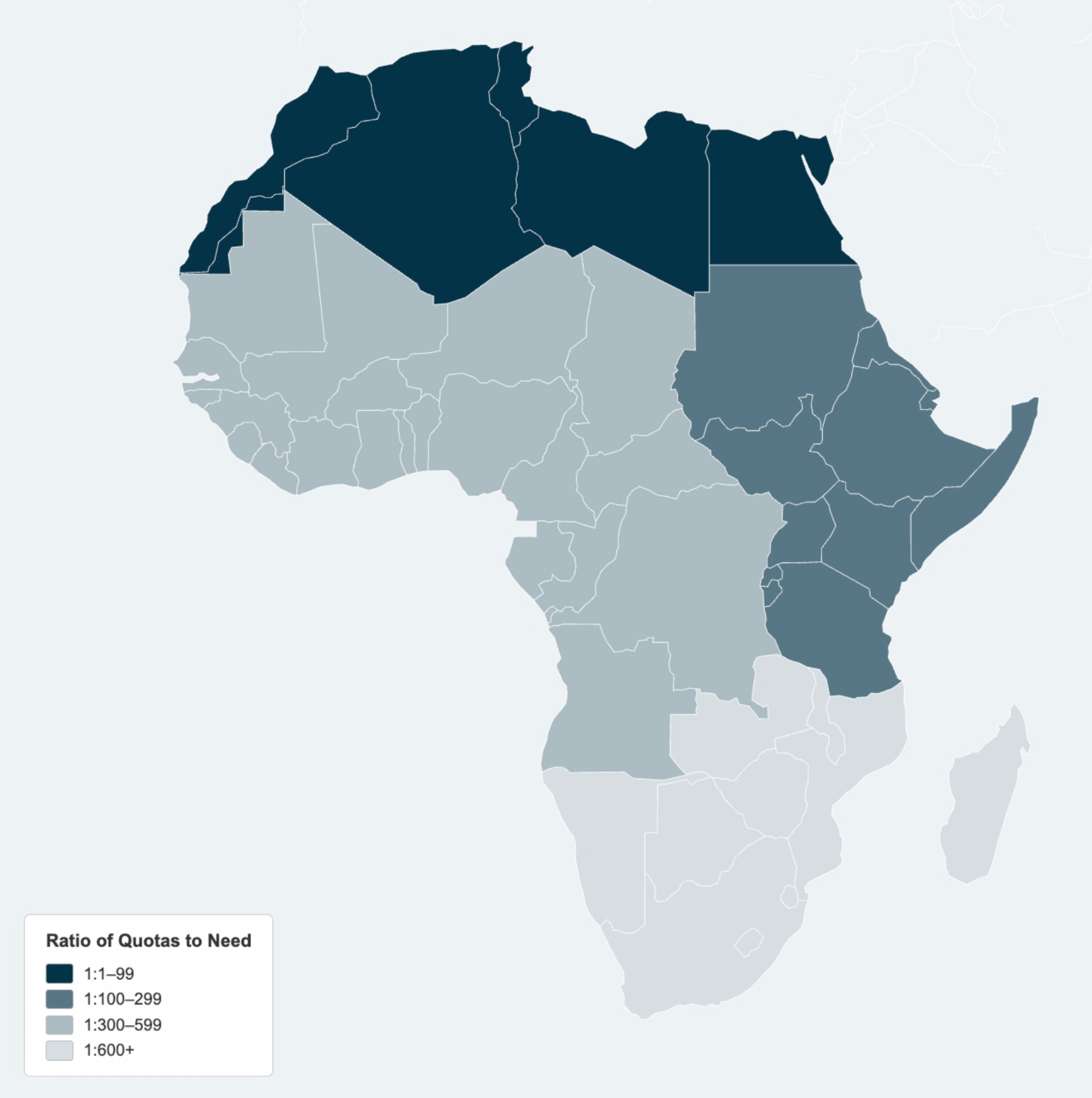
For example, a refugee identified as ‘in need of resettlement’ has the following probability of being referred for resettlement from these regions of Africa (see map below):
Southern Africa: 1:600
West & Central Africa: 1:350
East, Horn & Great Lakes: 1:150
Northern Africa: 1:35
Thus, it can be said that a refugee in need of resettlement is significantly more likely to have access to it the further north they are in Africa.
To be clear, this is not simply a matter of the difficulty of meeting needs where they are largest. Of any region in the world, the needs in southern Africa are by far the least, according to UNHCR’s projections, with “just” 40,000 refugees in need of resettlement in 2026. Yet for these 40,000 individuals, there are quotas for just 69 resettlement referrals.
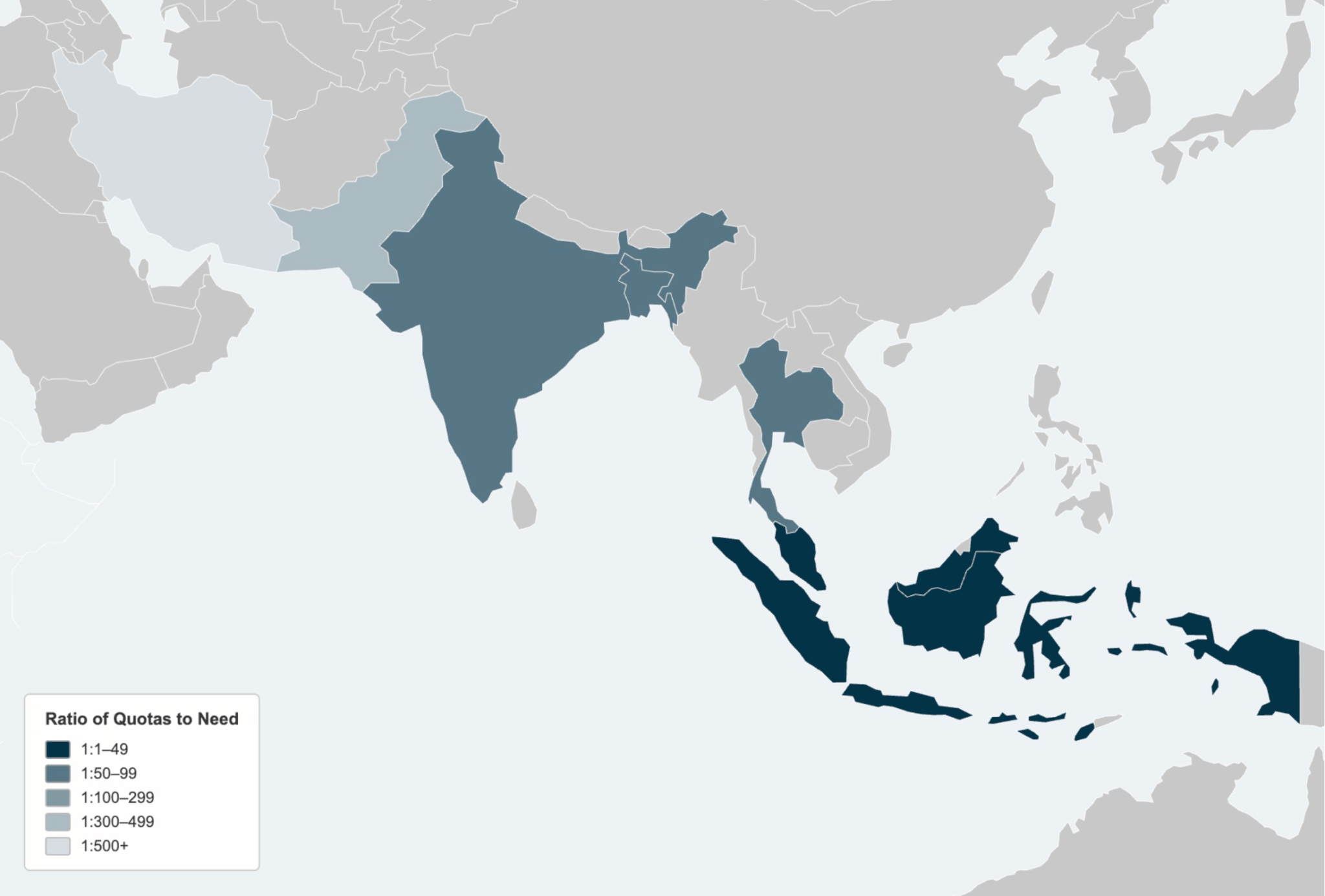
The same trend plays out in Asia as well (see map below), where the further southeast that a refugee travels in the region, the greater the likelihood they will have access to resettlement.
It is not a coincidence that better access to resettlement travels north in Africa and southeast in Asia. On both continents, these are the directions that many refugees travel along major migration routes in the hope of reaching safety. And here we can see evidence of the new version of the strategic use of resettlement, in which resettlement is used not to meet the needs of refugees along the whole of the route but instead as an instrument of foreign policy or form of leverage with what are perceived to be the frontline countries just across the border, at the end of the route. In Africa, these are the north African countries just across the Mediterranean from Europe, and in Asia these are the countries of Southeast Asia, just across the sea from Australia.
However, if the route-based approach were applied when setting resettlement quotas, then we would see a very different implementation of SUR. Rather than a concentration of resettlement opportunities at the end of a migration route and little opportunity elsewhere, we would see relatively equitable access to resettlement from start to finish along major migration routes, so that refugees in need of resettlement would have access to it wherever they are, without a resettlement “pull factor” adding to the already strong draw of the destination countries themselves. While it might be too late to reallocate this year’s quotas, it’s the right time to (re)consider next year’s.
By Shelby Quackenbush (Refugee Self-Reliance Initiative), Sofia Casas and Peter Ventevogel (UNHCR), and Anna Nicol (RefugePoint), on behalf of the full team of White Paper authors, including Awa Ahmed Haji...
Read Transforming Refugee Response: Vol. 9, Shifting Systems to Open and Expand Labor Mobility for Refugees Chol fled to Kenya at the age of 14 after conflict forced him...
Refugees are often trying to rebuild their lives in a new country while also dealing with the toll that persecution and displacement have taken on their mental health. Mental health...
Give Hope: Support Refugees Today
Make a gift to deliver lasting solutions for refugees and help them to build new lives.
Join our Community
Subscribe to get refugee stories, events, RefugePoint news, and more delivered right to your inbox.
By subscribing you agree to with our Privacy Policy & provide consent to receive updates from Refuge Point.
Give hope by supporting refugees today
Your gift will be used to deliver lasting solutions for refugees around the world, and help them rebuild their lives in safety.