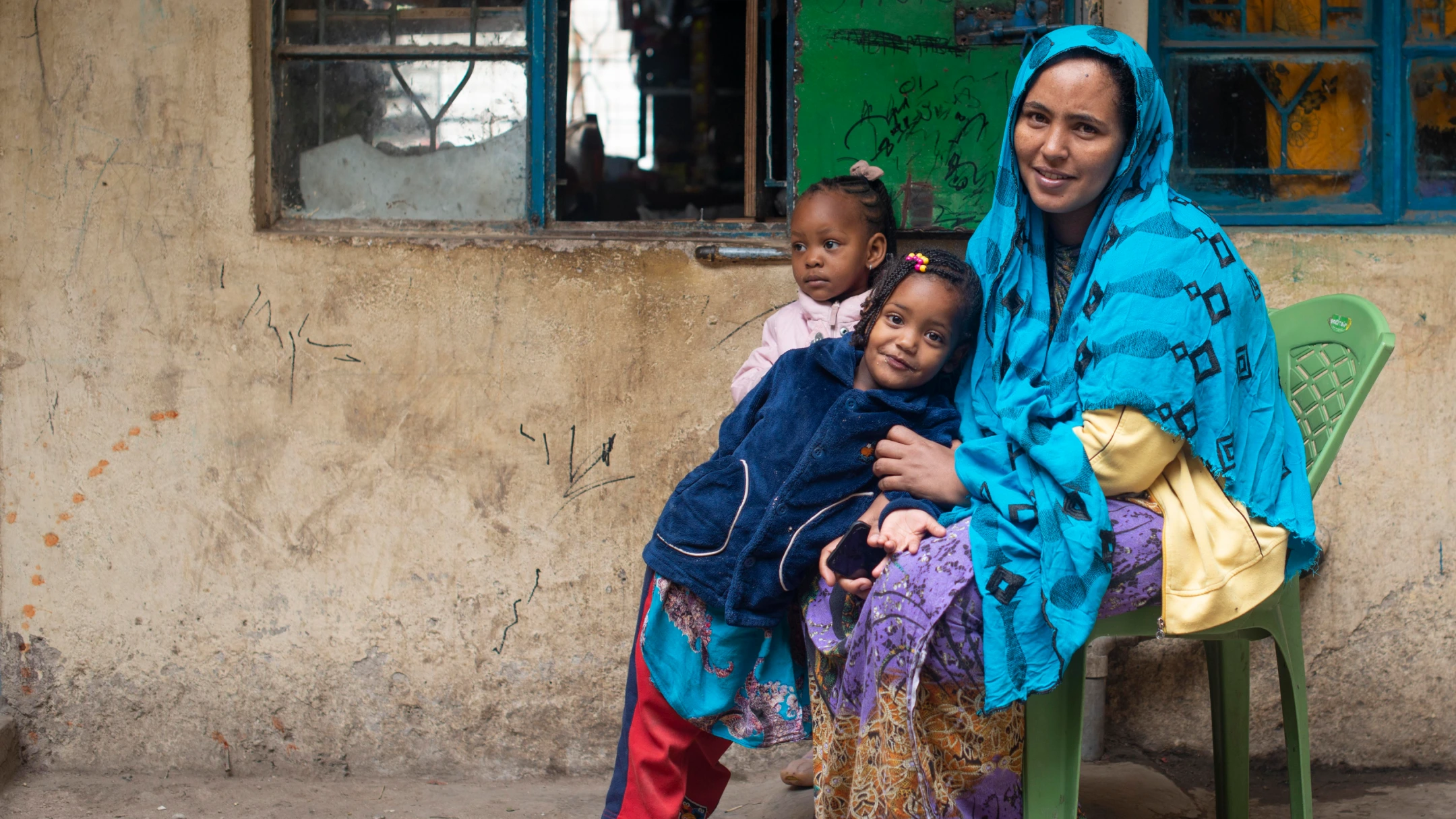
Chol fled to Kenya at the age of 14 after conflict forced him to leave his home in South Sudan. Like many refugees, he arrived carrying the uncertainty of displacement but remained determined to build a better future. Over the years, despite the challenges he faced as a refugee in a camp, he worked hard to pursue an education, develop professional skills, and use those skills to support community members by working as a community rehabilitation adviser in Kakuma Refugee Camp.
Despite his qualifications and determination, Chol continued to face significant barriers while living in Kakuma Refugee Camp: limited access to stable, formal employment, and a lack of awareness about available opportunities. Though ready and eager to contribute, he struggled to find a pathway that would allow him to fully leverage his skills and achieve long-term stability.
In 2021, Chol learned about RefugePoint’s Labor Mobility Program¹ and, with support, applied to Canada’s Economic Mobility Pathways Pilot (EMPP), which helps qualified and experienced refugees living in Kenya to immigrate to Canada through work-based visas. Through the program, Chol applied to healthcare positions in Canada and was selected by an employer to work as a Continuing Care Assistant at Northwood, a continuing care organization in Nova Scotia. He then relocated to Canada as a permanent resident.
Chol’s experience reflects the reality of many refugees who possess valuable talents, experience, and ambition but who face obstacles to meaningful employment and self-reliance. For refugees like Chol, labor mobility provides more than an opportunity to access to employment; it creates pathways to safety, economic inclusion, and the opportunity to rebuild their lives with dignity.
Labor Mobility: A Pathway Built on Skills
Labor mobility is increasingly being recognized as an important lasting solution for refugees, one that opens doors based on their skills and experience, rather than on the severity of their need. It also offers potential benefits for both refugees and host communities by connecting qualified individuals to workforce gaps across different sectors. Furthermore, labor mobility unlocks opportunities for self-reliance for refugees, many of whom have spent decades living in protracted situations.
At RefugePoint, our labor mobility work happens at multiple levels:
By directly supporting refugees to access employment opportunities through labor mobility programs.
By partnering with and strengthening other organizations working to advance labor mobility.
By influencing governments and other actors in both receiving and departure countries to design and implement more inclusive, refugee-centered labor migration systems.
We recently commissioned an external evaluation to better understand RefugePoint’s contribution to advancing labor mobility as a complementary pathway to protection. We are pleased to present this evaluation brief on Labor Mobility, which demonstrates that our efforts are contributing to meaningful systems change, advancing policies, practices, and mindsets to recognize refugees’ skills and expand equitable access to labor mobility pathways.
Key Findings: RefugePoint as a Lead Contributor in Labor Mobility
The evaluation found that RefugePoint has been a lead contributor to the design and development of labor mobility pathways for refugees and other forcibly displaced populations.
Providing Direct Support to Refugees Accessing Labor Mobility Pathways
Alongside systems-level efforts, RefugePoint provides direct support to refugees navigating labor mobility processes. This includes identifying qualified candidates, supporting job matching with employers, and preparing refugees through application processes, interviews, and pre-departure requirements. Through this work, RefugePoint, TBB and other partners have supported more than 1,200 displaced people in accessing labor mobility pathways.
For refugees, the impact extends beyond employment. Labor mobility provides a pathway to protection, stability, and self-reliance, enabling individuals to apply their skills, secure sustainable livelihoods, and contribute meaningfully to their new communities.
Advancing Collaboration and Field Building for Labor Mobility
RefugePoint plays an important role in strengthening collaboration and coordination across the labor mobility ecosystem. As a founding member of the Global Task Force on Refugee Labor Mobility, RefugePoint helps connect practitioners across the ecosystem, including through the Task Force’s Refugee Labour Mobility Network, launched in 2023 to give stakeholders a shared platform to exchange lessons, troubleshoot common challenges, and strengthen their approaches to labor mobility. Refugee representatives with lived experience also help shape this exchange, advising other stakeholders directly.
Multiplying Impact Through Systems Change
One of RefugePoint’s goals is to change systems by addressing the policies, practices, resources, relationships, and mindsets that influence access to labor mobility pathways. As highlighted in Transforming Refugee Response: Vol. 9, RefugePoint has played a lead contributor role in demonstrating that labor mobility can function as a viable and scalable complementary pathway to protection.
Through its role in the EMPP, RefugePoint has contributed to shaping more inclusive systems, supporting policy flexibilities, improving processes, and demonstrating proof of concept for labor mobility pathways globally.
RefugePoint’s efforts have also contributed to shifting mindsets across the sector, from viewing refugees primarily as beneficiaries of aid to recognizing them as individuals with skills, agency, and the capacity to contribute to economies and societies. These shifts are critical to embedding labor mobility as a durable solution within the broader refugee response system.
Labor mobility is not a humanitarian tool addressing the needs of the larger refugee population. Rather, it levels the playing field so that people, like Chol, can gain access to labor pathways based on their skills and qualifications and not face exclusion from such opportunities because they happen to be a refugee.
1 An immigration pathway through which refugees use their skills and experience to obtain jobs that allow them to relocate to a safe, new country.
By Shelby Quackenbush (Refugee Self-Reliance Initiative), Sofia Casas and Peter Ventevogel (UNHCR), and Anna Nicol (RefugePoint), on behalf of the full team of White Paper authors, including Awa Ahmed Haji...
With refugee resettlement opportunities at their lowest level in decades, it is all the more important to consider how those coveted quotas are allocated across regions and countries. The strategic...
Refugees are often trying to rebuild their lives in a new country while also dealing with the toll that persecution and displacement have taken on their mental health. Mental health...
Give Hope: Support Refugees Today
Make a gift to deliver lasting solutions for refugees and help them to build new lives.
Join our Community
Subscribe to get refugee stories, events, RefugePoint news, and more delivered right to your inbox.
By subscribing you agree to with our Privacy Policy & provide consent to receive updates from Refuge Point.
Give hope by supporting refugees today
Your gift will be used to deliver lasting solutions for refugees around the world, and help them rebuild their lives in safety.