/ Blog / Building Self-Reliance Through Community Mental Health
Self Reliance
Building Self-Reliance Through Community Mental Health
All posts
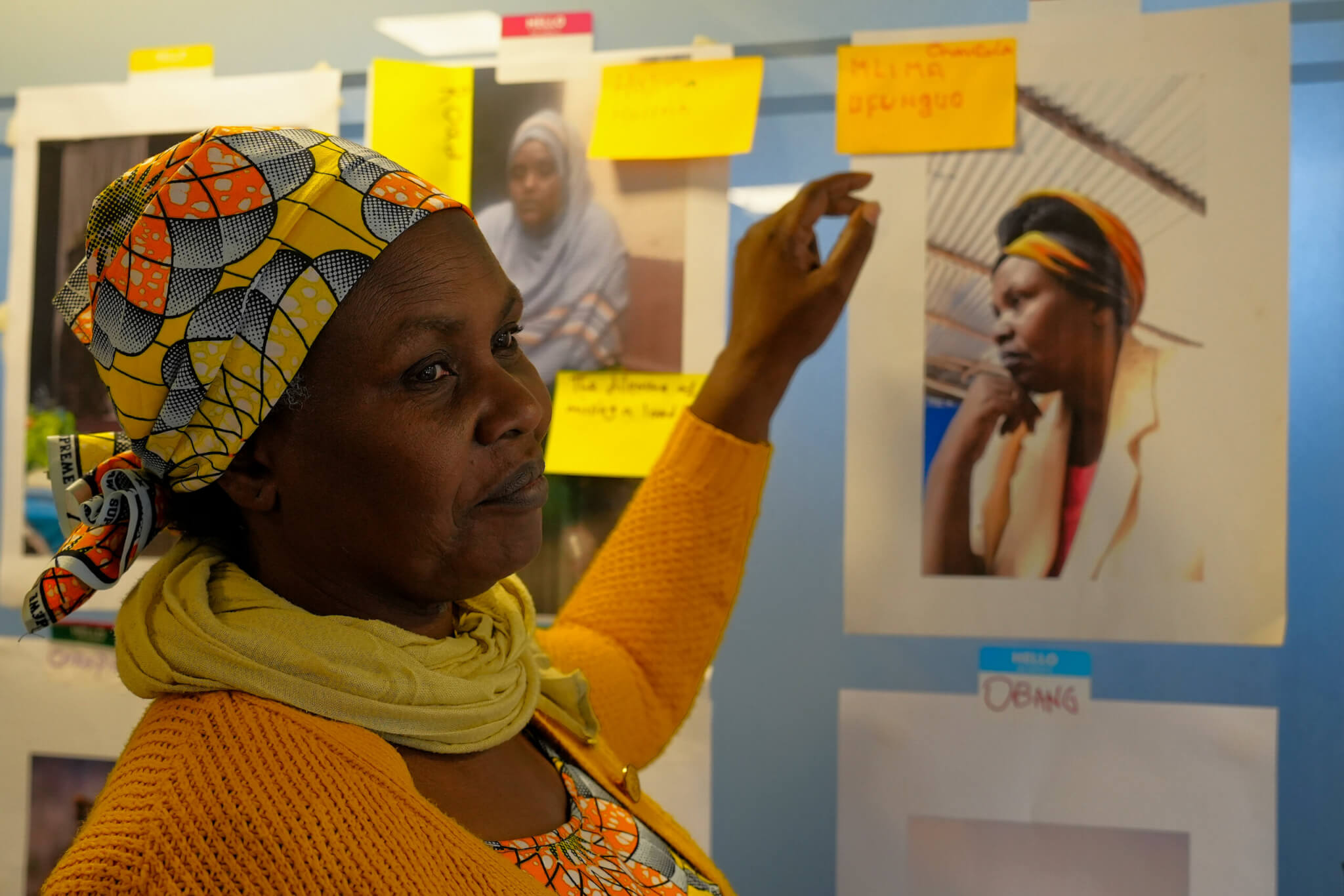
A RefugePoint staff members views the gallery of images at a recent Photovoice event in Nairobi, Kenya. Photo: Carolyne Njung'e, RefugePoint
Published on14 September 2026
By Diana Karua, RefugePoint
Refugees are often trying to rebuild their lives in a new country while also dealing with the toll that persecution and displacement have taken on their mental health. Mental health and psychosocial wellbeing greatly influence people’s ability to engage in livelihoods, form supportive relationships, access the resources and services they need, and envision and pursue their goals. Ensuring that refugees have access to mental health support is critical to helping them move towards self-reliance and is therefore a fundamental part of RefugePoint’s self-reliance programming and is often among the first services clients receive upon enrollment in the Urban Refugee Protection Program (URPP) in Nairobi, Kenya.
“Self-reliance is not purely economic; it is also psychological and social. A healthy mind, free of stress, is what allows a person to grow, provide, and feel whole.” -Ahmed, a RefugePoint client
RefugePoint provides mental health and psychosocial support services such as:
One-on-one counseling
Group therapy
Support group services that enable clients to develop self-awareness, deal with trauma, resolve issues, cope with challenges, build social connections, and strengthen peaceful coexistence.
A key component of RefugePoint’s MHPSS support includes working directly with communities. RefugePoint’s Community-based Mental Health and Psychosocial Support (CB-MHPSS) is rooted in the understanding that communities and refugees with lived experience possess the wisdom for support and healing. Through collaboration with communities, the CB-MHPSS component of our programming enhances mental health awareness, contributing to reduced stigma, and fosters community resilience and well-being by holding space for experiential community activities such as Photovoice.
Photovoice: Trauma Recovery and Narrative Reclamation Through Photography
In June 2026, RefugePoint organized a Photovoice exhibition and storytelling session that created a safe space for refugee clients to document and share their experiences through photographs and personal narratives, creating opportunities for reflection, dialogue, and connection.
A key component of the Photovoice experience is choice. By encouraging people to decide what they want to share and in what way, Photovoice empowers individuals to control the narrative about what meaning they attach to their experiences. As Anne-Marie, a RefugePoint CB-MHPSS Senior Associate, explains, “Photovoice is a powerful tool for trauma recovery and narrative reclamation. Rather than positioning clients as recipients of care, Photovoice centers them as the authors of their own stories.”
By encouraging people to decide what they want to share and in what way, Photovoice empowers individuals to control the narrative about what meaning they attach to their experiences.
A Trauma-Informed Approach to Creative Expression
One key consideration when working with refugee populations, and with individuals carrying the weight of experiences they survived, is ensuring that participants fully understand the process and can give informed consent.
To this end, a training focusing on consent was held with the core participants prior to the exhibition. Participants learned about informed consent, ethical considerations related to privacy, safety, and photographing others, RefugePoint’s communications consent process, and how to link photographs with their story. Participants were then encouraged to reflect on their experiences and choose a story or photos to share during the exhibition. Participation remained voluntary throughout the process.
The photographs were then collected, printed, and mounted, with each image labeled with its author and the story title to facilitate a gallery crawl. During the exhibition, participants were invited to share what they wanted others to see and understand about their lives.
A Photovoice event participant exhibits her photograph, a self-portrait. Photo: Carolyne Njung’e, RefugePoint
Mental health and psychosocial support staff were present throughout the activity to ensure participants engaged safely. Interpreters also enabled participants to express themselves in their preferred languages, strengthening inclusion and psychological safety. Together, these measures created an environment in which participants explored difficult experiences while maintaining ownership of their stories.
Stories of Resilience, Recovery, and Self-Reliance
Together, the stories reflected a wide range of experiences, including displacement, grief, livelihood challenges, disability, discrimination, entrepreneurship, community support, faith, health challenges, protection risks, recovery, resilience, and self-reliance.
Stories of entrepreneurship emerged repeatedly. Participants described transitioning from unsafe working conditions to more sustainable livelihood opportunities, adapting their businesses during crises, and developing skills that enabled them to support their families and others in their communities. Participants also spoke about the importance of women’s groups, peer support networks, faith communities, and psychosocial services in helping them find strength during difficult periods. These spaces offer not only practical support but also a sense of belonging, encouragement, and hope.
Participants also used their stories to advocate for dignity and inclusion. One parent highlighted the discrimination and stigma faced by children living with albinism, calling for greater awareness, protection, and understanding. Others reflected on challenges related to disability, long-term displacement, and social exclusion while emphasizing resilience, determination, and the importance of being seen beyond labels or circumstances.
Community Mental Health Builds Resilience and Self-Reliance
The Photovoice exhibition and storytelling session demonstrated how community mental health initiatives contribute to RefugePoint’s broader goal of supporting refugees on their journey toward self-reliance.
By creating a safe, participatory, and trauma-informed environment, the activity supported participants to reflect on their lived experiences, recognize their strengths, build peer connections, and engage in storytelling that promoted healing. Together, these experiences strengthened participants’ confidence, resilience, sense of connection, and agency, reinforcing the psychological and social capacities that underpin self-reliance. When refugees choose how their stories are told and what they want to share, they can actively reclaim their power, further strengthening their ability to rebuild, reconstruct, and move towards self-reliance.
With refugee resettlement opportunities at their lowest level in decades, it is all the more important to consider how those coveted quotas are allocated across regions and countries. The strategic...
Read Transforming Refugee Response: Vol. 9, Shifting Systems to Open and Expand Labor Mobility for Refugees Chol fled to Kenya at the age of 14 after conflict forced him...
Who Were the Lost Boys of Sudan? In the mid-1980s, civil war erupted in Sudan. Government-backed militias launched brutal attacks on villages in southern Sudan, killing numerous civilians. Thousands of...
Give Hope: Support Refugees Today
Make a gift to deliver lasting solutions for refugees and help them to build new lives.
Join our Community
Subscribe to get refugee stories, events, RefugePoint news, and more delivered right to your inbox.
By subscribing you agree to with our Privacy Policy & provide consent to receive updates from Refuge Point.
Give hope by supporting refugees today
Your gift will be used to deliver lasting solutions for refugees around the world, and help them rebuild their lives in safety.