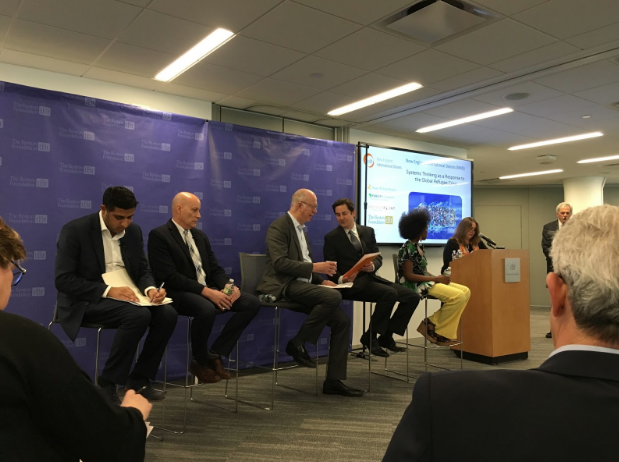
Ina Breuer, the Executive Director of New England International Donors introduced Paul Grogan, the President and CEO of The Boston Foundation who welcomed the audience to The Boston Foundation’s downtown Boston space.
This group of stakeholders, from a wide variety of sectors: non-profits, philanthropy, academia, journalism, grassroots work, and the business field, examined how to mobilize collectively and promote opportunities for refugees to become self-reliant, contributing members of their host communities. Self-reliance is the social and economic ability of an individual, a household or a community to meet its essential needs in a sustainable manner.
Mr. Gergen began by introducing the concept of Systems Change and laying out the foundation for the conversation. Ms. Uwiringiyimana highlighted the necessity of self reliance in her own life by discussing her personal experience living as a refugee child and how her mother was able to support the family through a small business, when there was no humanitarian aid available.
Mr. Buscher and Mr. Chanoff discussed their respective organizations’ coalition building work through the Self-Reliance Initiative. This Initiative is a joint effort by a coalition of organizations, government agencies, foundations, research institutes and other partners focused on promoting opportunities for refugees to become self-reliant and achieve a better quality of life. The aim of this initiative is to reach five million refugees with self-reliance programming in five years, and ultimately help usher in a needed paradigm shift in refugee response.
As Mr. Chanoff explained “In terms of refugees, we are at a new global moral reckoning point with more than 66 million people displaced today, more now than at any other time in history. This is the global challenge we are here to address today.”
Lastly, Mr. Joshi discussed the role of the B Team and the private sector in terms of addressing the global refugee crisis. He highlighted how “we have to find a new way for humanity to steward our planet and its resources, and we have to do it quickly.” Mr. Joshi referenced the B Team’s new report: Refugees are an Opportunity for Humanity.
After these remarks the floor was opened to questions and comments.
These articles provide further information on the need for Systems Change around the world today:
RefugePoint finds lasting solutions for the world’s most at-risk refugees supports the humanitarian community to do the same. To learn more about this topic or RefugePoint’s work generally please contact: info at refugepoint dot org
The people most affected by decisions should have a meaningful role in making them. This simple principle has increasingly shaped the way we at RefugePoint think about our work. For...
By Shelby Quackenbush (Refugee Self-Reliance Initiative), Sofia Casas and Peter Ventevogel (UNHCR), and Anna Nicol (RefugePoint), on behalf of the full team of White Paper authors, including Awa Ahmed Haji...
With refugee resettlement opportunities at their lowest level in decades, it is all the more important to consider how those coveted quotas are allocated across regions and countries. The strategic...
Give Hope: Support Refugees Today
Make a gift to deliver lasting solutions for refugees and help them to build new lives.
Join our Community
Subscribe to get refugee stories, events, RefugePoint news, and more delivered right to your inbox.
By subscribing you agree to with our Privacy Policy & provide consent to receive updates from Refuge Point.
Give hope by supporting refugees today
Your gift will be used to deliver lasting solutions for refugees around the world, and help them rebuild their lives in safety.